GameCuki is reader-supported. When you buy through links on our site, we may earn an affiliate commission at no extra cost to you. As an Amazon Associate I earn from qualifying purchases. Learn more.
Choosing between the RTX 5060 vs RTX 5060 Ti sounds simple until you see that the Ti comes in two memory sizes and sits only a step up in price. Both are Blackwell cards built for 1080p and 1440p. The real question is whether the Ti’s extra cores and, above all, its optional 16GB of VRAM justify paying more.
Best for 1080p on a Budget
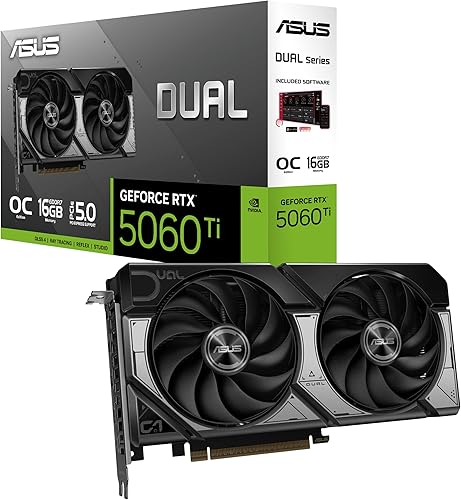
ASUS Dual RTX 5060 OC 8GB
Bottom LineBuy it if you play at 1080p, want the lowest price and the lowest power draw, and do not plan to push high texture settings at 1440p.
Neither card is sold in a single form. NVIDIA’s partners, such as ASUS, build the versions you will actually buy, so cooler size, clocks and street price vary by model. We paired two ASUS Dual cards above so the cooler is the same and only the GPU and memory differ. Building a whole PC around one of these? Our RX 9070 XT vs RTX 5070 Ti comparison shows what the next tier up looks like.
The RTX 5060 has 3,840 CUDA cores. The RTX 5060 Ti has 4,608, which is exactly 20% more. Boost clocks are almost the same at 2.50 GHz and 2.57 GHz, so the core count is the main reason the Ti is faster. The Ti also has more ray tracing and AI hardware, rated at 72 TFLOPS and 759 AI TOPS against 58 TFLOPS and 614 AI TOPS.
NVIDIA’s artwork for the GeForce RTX 5060 family. (Image: NVIDIA)
Do not expect a full 20% jump in games, though. Both cards use the same 128-bit bus and the same 28 Gbps GDDR7, which works out to 448 GB/s of bandwidth for each. Because memory speed is identical, the real-world gap is likely to be smaller than the core count suggests, especially at higher resolutions where bandwidth matters more.
VRAM: 8GB vs 16GB Is the Deciding Factor
The RTX 5060 is only sold with 8GB of GDDR7. The RTX 5060 Ti comes in 8GB and 16GB versions, and the two Ti models use the same GPU, the same 4,608 cores and the same clocks. The 16GB card simply has more memory chips.
That matters more than the shader count. At 1080p, 8GB is usually fine. At 1440p with high texture settings, or in newer memory-hungry games, an 8GB card can run out of VRAM, which shows up as stutter or textures that load late. A 16GB card avoids most of that.
Go with the RTX 5060 if you stay at 1080p and mostly play esports or older titles. Be careful with the 8GB Ti: it costs more than the 5060 but shares its VRAM ceiling, so the 16GB version is the one that changes the experience.
Power Draw and PSU Needs: The 5060 Is Easier to Fit
NVIDIA lists 145 W total graphics power for the RTX 5060 and 180 W for the RTX 5060 Ti. The recommended system power is 550 W and 600 W, respectively, and both cards use a single 8-pin PCIe connector (or an adapter for a 300 W or higher PCIe Gen 5 cable). If you are dropping a card into an older prebuilt with a modest power supply, the base 5060 is the safer match.
DLSS 4 and Ray Tracing: Same Features, Different Headroom
Both cards support DLSS 4, including Multi Frame Generation, and use fourth-generation RT cores and fifth-generation Tensor cores. Feature support is identical, so the difference is how much raw speed you have before upscaling. Frame generation works best when you already have a smooth base frame rate, so the faster Ti gives it a better starting point. Ray tracing is demanding on both, and either card will usually need DLSS to run it comfortably.
RTX 5060 vs RTX 5060 Ti: Full Specs
Feature
RTX 5060
RTX 5060 Ti
Architecture
NVIDIA Blackwell
NVIDIA Blackwell
Release date
May 2025
April 16, 2025
CUDA cores
3,840
4,608 Wins
Boost clock
2.50 GHz
2.57 GHz Wins
Memory
8GB GDDR7
8GB or 16GB GDDR7 Wins
Memory bus
128-bit
128-bit
Memory bandwidth
448 GB/s
448 GB/s
AI performance
614 AI TOPS
759 AI TOPS Wins
RT performance
58 TFLOPS
72 TFLOPS Wins
Total graphics power
145 W Wins
180 W
Required system power
550 W Wins
600 W
Upscaling
DLSS 4 with Multi Frame Generation
DLSS 4 with Multi Frame Generation
Launch price
Lower Wins
Higher
And the Winner Is…
WinnerRTX 5060 Ti (16GB)
The RTX 5060 has real strengths: it costs less at launch, draws 35 W less, and runs on a smaller power supply. For a 1080p build on a tight budget, it is a sound card. But the RTX 5060 Ti with 16GB pulls ahead where it counts. It has 20% more cores, stronger ray tracing and AI hardware, and double the memory, so it is more comfortable at 1440p and likely to hold up longer as games demand more VRAM. In this RTX 5060 vs RTX 5060 Ti matchup, the 16GB Ti is the better buy for most people who can stretch the budget. Pick the 5060 if you game at 1080p, want the lowest price, or your power supply is limited. Skip the 8GB Ti, which costs more without fixing the VRAM limit.
If you game at 1080p and play mostly esports or older titles, the RTX 5060 gives you most of the experience for less, and the Ti is not worth chasing. If you play at 1440p, like high texture settings or want a card that lasts several years, the RTX 5060 Ti 16GB is worth the premium. Whichever you choose, check current listings before buying, because street prices move and a small price gap can swing the decision.
I'm Sean, and I write the comparisons on GameCuki. I cover anything gamers weigh up before buying: consoles and handhelds, PC components and gaming laptops, monitors, controllers, headsets and accessories, plus subscriptions and services like Game Pass and PlayStation Plus. I put both options on the same checklist, using official specs, professional reviews and owner feedback, and I only mention what owners say when at least two of them report the same thing. Every comparison ends with one clear verdict and the type of player each option suits. I don't accept free products or payment from brands, and what I write comes from research, not my own use of the products. You can read my full process on our How We Review page.
Areas of Focus
Controller Match-UpsHeadset Match-UpsConsole vs. ConsoleSpecs & Latency